Picañol regularly uses ‘beautiful people’ in the sales of its weaving machines. Miss England, and later Miss World 1974, Helen Morgan, advertised Picañol weaving machines at the open day of Premier Mill (United Kingdom). Also in 1974, Picañol officially inaugurated the automatic assembly line. Each shift had 12 minutes to finish its assembly work, following which a bell would sound and the loom moved on. Thanks to this new method, over forty machines could be assembled each day. The machines in the production departments were also replaced. Among others, two ‘Olivetti’ numerically controlled coordinate drilling and milling machines were purchased. The functioning of the new technology was explained to Charles and Bernard Steverlynck (picture).
Friday, December 9, 2011
Tuesday, December 6, 2011
The first electronically controlled flying shuttle machine
At the ITMA exhibition in Paris (1971), Picañol surprises the textile industry with the MDC, the world’s first electronically controlled fl ying shuttle machine. MDC stands for Mono Disc Control, referring to the electromagnetically controlled clutch-and brake unit which makes it possible to increase the speed of this 188 cm machine to 220 picks per minute. The MDC is also the first weaving machine with pushbuttons instead of levers.
Tuesday, November 29, 2011
Picañol at Inlegmash in Moscow
At the Inlegmash-exhibition in Moscow, Picañol used the defeat of the Belgian football team against the Soviet Union at the World Cup in Mexico to attract attention. The Russian inscription reads: ‘Our looms are much better than our football team. Still, our sincere congratulations’. Pavel Popovitch, the Russian cosmonaut who made 49 revolutions around the earth in 1962, appreciated the humor of it.
Monday, November 21, 2011
New assembly hall
At the end of 1969, Picañol increased the level of recruitment. At that time, 2,137 laborers and 418 servants were employed at Ieper, causing an acute lack of space. Therefore, the surrounding area of the factory in Ieper turned into an enormous building site. In the spring of 1970, construction started on the new assembly hall, which had to be ready before the vacation. For the first time, a ring road was also built. The number of showers and water connections for washing were also increased and the "rolling stock" was renewed. For example, in March, new commercial vehicles were put into use. The cars, with closed bodies, answered to the name Hannomag (Hannover), with a loading capacity of 1,700 kg. Drivers Lucien Wyckaert and André Mechelen used both cars to organize shipments over domestic and international routes.
Thursday, November 17, 2011
Start of casting work for third parties
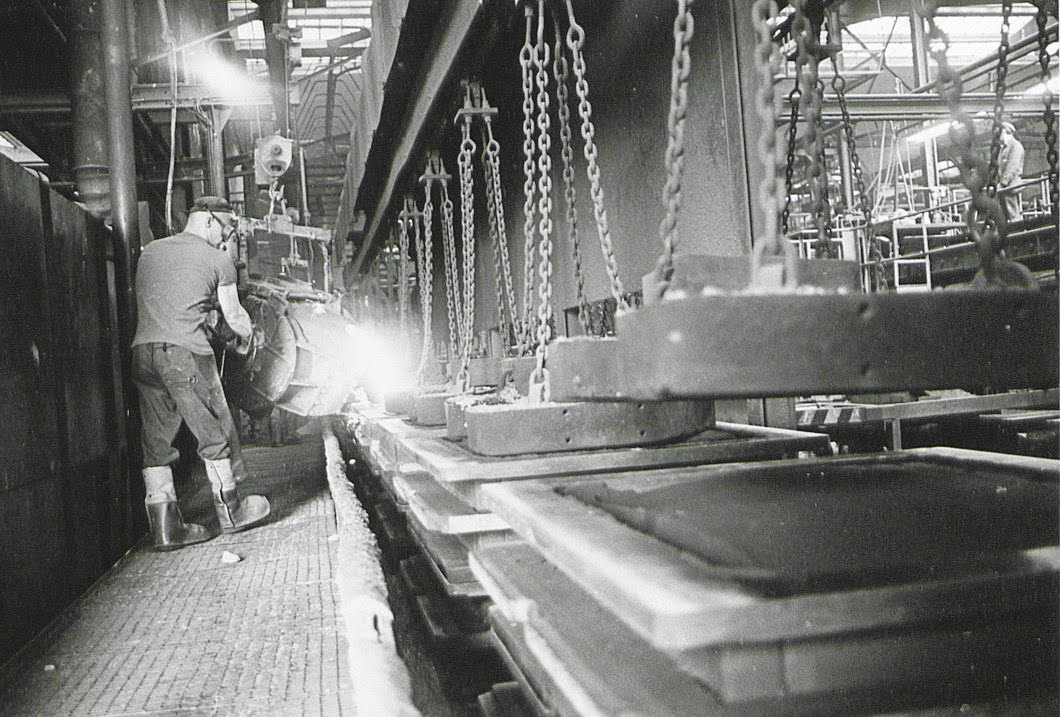
In 1969, Picañol started performing casting work for third parties. In 1970, approximately two-thirds of the time was used for own production, and the other one-third was used for the production of casting work for external customers, such as Ford Tractor.
Monday, November 14, 2011
Picañol in Ethiopia and the visit of Queen Juliana
In the spring of 1969, Picañol took part in an exhibition in Asmara in Ethiopia. The exhibition itself was primarily designed to enable visitors to see what was produced in Ethiopia. Picañol was present with a C.M. President featuring a heavy twill fabric, with a speed of 230 wefts per minute. For the correspondents of Picañol it was a pleasure to see how many visitors stopped to admire the loom. Even a British competitor exhibiting its own looms could not believe how our looms could run this fast. Apart from visits from Sudan and Kenya, Queen Juliana of the Netherlands also visited the exhibition. She was very interested in the origins of our looms, stating - "Well, it's amazing all the things that are manufactured in the Benelux.”.
Monday, November 7, 2011
Picañol in the Far East
At the end of 1968 the Danish company Maersk inaugurated a new line to Asia, providing Picañol with direct access to the most important markets in the Far East. The "Charlotte Maersk "(13,900 GRT) was the first boat to ensure the new link between Europe and the Orient. After loading the familiar Picañol crates at Antwerp, some 164 President looms left for Hong Kong. Meanwhile, 100 looms went to our customer Textile Alliance, with the other 64 destined for East Asia Textiles Ltd.
Subscribe to:
Posts (Atom)